

Recent performance has understandably raised questions from clients sharing in this difficult drawdown. As the most experienced trader of our strategies, I want to address some of the key concerns directly. After more than 20 years navigating drawdowns, I’ve learned the importance of relying on empirical evidence—not recency bias, fear-based assumptions or untested theories. That principle guides my responses as I answer the following questions:
Q: Isn’t one of the benefits of autotrading that your programs go up when the market goes down?
Q. Why isn't my program taking advantage of the volatility?
Q: The drawdown in my account is larger than any previous one—doesn’t that mean your strategies are broken?
Q. Why are you confident that this drawdown will end?
Q. How are you and other clients managing this drawdown in your accounts?
Q. If my account is nearing my "uncle point" — what should I do?
Q. What should I expect during this high volatility period?
_______________________________________________________________
Q: Isn’t one of the benefits of autotrading that your programs go up when the market goes down?
That’s certainly the goal—and our strategies have a strong history of doing just that, including strong net gains for our clients during the 2022 bear market. However, they aren’t designed to move opposite the market in perfect sync; a consistently inverse correlation would be unsustainable and ultimately unprofitable over time.
While it’s not typical for our programs to post losses during equity market declines, it’s also not unprecedented. Let’s look at historical context. In the last seven years the S&P 500 has declined 29 prior times. During those months, our strategies:
Delivered positive returns in 17 months (60%)
Declined but outperformed the index in 9 months (30%)
Underperformed in 3 months (10%)
March’s results were deeply disappointing—no question—but it’s important to view them in perspective. A review of the historical performance of the individual programs using the Portfolio Builder shows that the Meta 50, Select 150 and Max 150 programs each had worse months in the past (Sep 2021 - Jan 2022 just before the last bear market commenced). Meta 30, Trader 50 and Max 500 programs also endured comparable equity declines (within ~1%) during that same bull-to-bear transition period and just before they began taking advantage of the volatility and performing well.
Importantly, even with some sizable losing months, they’ve generated strong cumulative gains across those 29 down months that stocks declined significantly. (Data based on the Max 500 program, a good proxy for the combined performance of the individual iQ autotrading strategies.) That does not guarantee the same thing will happen this time, but there is precedent and sound logic for remaining hopeful.
Bottom line: Sustained volatility is where our edge shines. Bear markets and recessions often unfold over many months—or even years—making short-term returns just noise. The true value of autotrading is revealed over the full market cycle, which may be just beginning.
Q. Why isn't my program taking advantage of the volatility?
Autotrading profits rely on four key factors:
- Number of trades
- Win rate
- Average gain of winners
- Average loss of losers
That said, drawdowns occur when the gains from winning trades don’t outweigh the losses over a series of trades. In volatile environments—where both gains and losses tend to be larger—the drawdown can be more severe if win rates decline too much, or if the increase in average gain is less than the increase in average loss.
Over the past six months, equity markets have shifted between two extremes: a record-setting rally to all-time highs, followed by the fifth-fastest correction in the past 80 years. This kind of whipsaw environment challenged our algorithms and led to a modest dip in win rates—though still acceptable and within historical norms. (Notably, Meta 30’s win rate during this period actually exceeded its win rate during the 2022 bear market, when it posted a 76.6% gross return in live trading.)
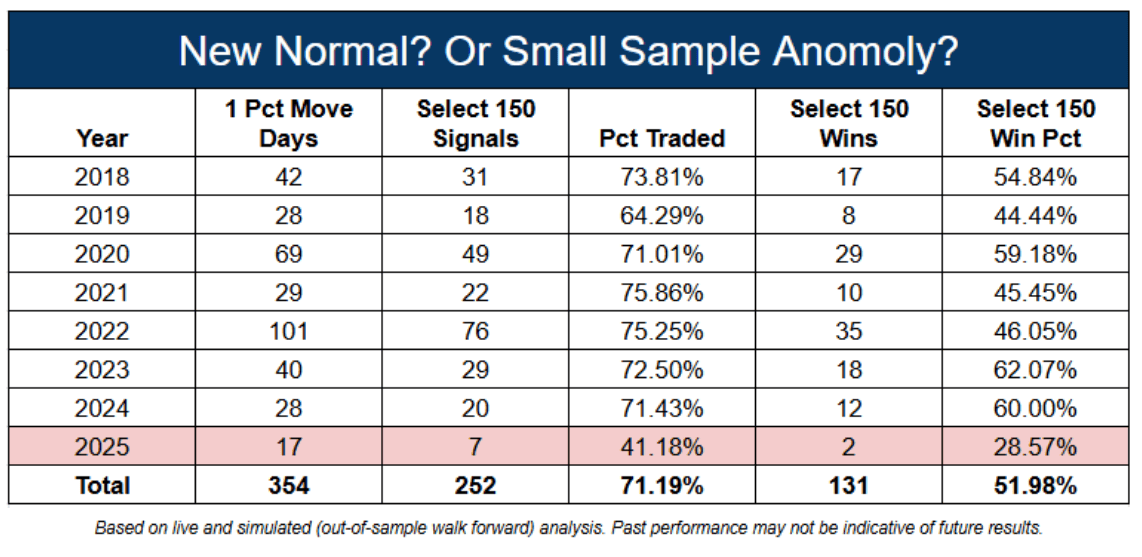
So the challenge hasn’t been trade volume or win rate—it’s been the average size of the winning trades. This issue became apparent over the course of 2024, when only 11% of trading days (just 28 in total) featured a “1% move” from open to close—the lowest count since 2018, and well below the ~20% historical average of the prior six years. Even more challenging, only five “1% move” days occurred in Q4. These “1% move” days are critical for our systems, as they can (though not always) account for the majority of profits in any given year. When they’re scarce, performance often lags—and that was a key factor behind the drawdown last fall and weaker than average returns for the year.
In Q1 2025, volatility returned, with 17 of these “1% move” days recorded through early April. However, as the market shifted abruptly from a bull run to a sharp correction, it generated conflicting signals. Many strategies stayed on the sidelines, and when trades did occur, results were unusually weak—likely due to short-term randomness, not flaws in the systems. For example, Select 150 traded on just seven of those volatile days and posted only two wins. While that may seem concerning, it’s a statistically insignificant sample for a strategy that has historically maintained a 52% win rate on similar days since 2018.
When chaotic market conditions and poor autotrading performance occur in a short period of time, it’s natural to assume a direct correlation and to catastrophize potential outcomes. While it’s wise to consider worst-case scenarios and have a plan, it’s equally important to weigh more probable outcomes as well.
Given the data in the table above, it's reasonable to expect the number of “1% move” days to rise—potentially reaching levels similar to the volatile 2020 and 2022 markets which enjoyed 70 - 100 such days each year—and to expect performance metrics to revert toward their long-term averages. In my view, that makes now a compelling time to stay the course and remain positioned for the opportunities this rising volatility could bring us.
Q: The drawdown in my account is larger than any previous one—doesn’t that mean your strategies are broken?
No. The strategies are functioning as designed. While drawdowns are understandably frustrating, they’re a normal and unavoidable part of trading.
A common, effective technique for evaluating drawdowns is to compare them to historical ones. But context matters. As we’ve shared in countless conversations and webinars: “Your biggest drawdown is always ahead of you. Be prepared for a 25–50% larger drawdown—or more. ”
Why? Because as market cap and index values grow, so do daily trading ranges. This means both winning and losing trades tend to become larger over time. So when a losing streak occurs in the future, the average loss per trade may be slightly larger—resulting in a deeper drawdown than past ones.
This isn’t a theory—it’s a statistical inevitability. That’s why current drawdown levels exceed previous records. For a clear example, consider our Meta 50 program (core to Select 150, Max 500, and structurally similar to Meta 30), measured using peak-to-trough daily return drawdowns:
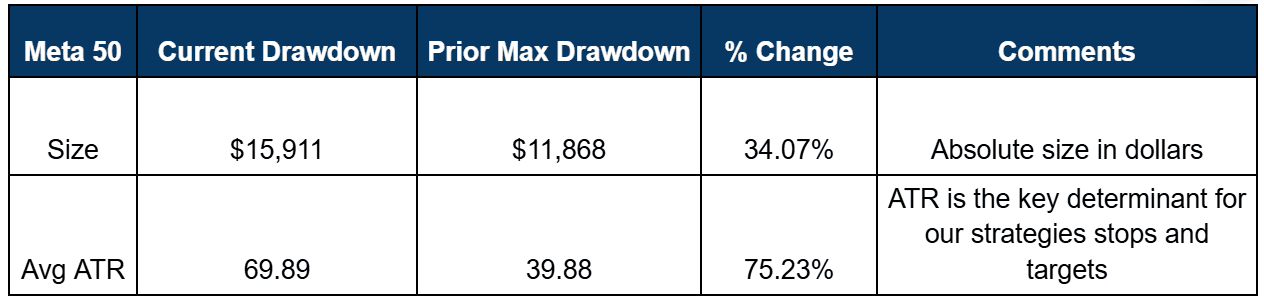
This pattern is consistent across all of our programs. While most are currently experiencing drawdowns larger than their previous maximums, the average trading ranges—measured by Average True Range (ATR)—are 46% higher than during those prior drawdown periods. In other words, today’s larger drawdowns are within expectations when adjusted for the elevated volatility of the current market environment.
Q. Why are you confident that this drawdown will end?
Market volatility is the fuel that drives autotrading returns—and like it or not, it appears to be here for the foreseeable future. Some of it stems from unexpected news events, and while we've found ourselves on the wrong side of a few trades this year, that’s part of the natural randomness of short-term trading. With daily risk capped for each program, I believe it’s only a matter of time before we start landing on the right side of some of these powerful moves.
Even a 0.5% move in the index can generate gains of 5–10% or more on a single trade, while risking just 3–5%—or less, depending on the program. Occasionally, “whale trades” emerge. For example, last week saw multiple 200+ point swings in the S&P 500, each worth over $10,000 per contract—exactly the kind of opportunity many of our strategies are designed to capture. With this favorable risk-reward dynamic, current drawdowns have the potential to recover much faster than one might expect.
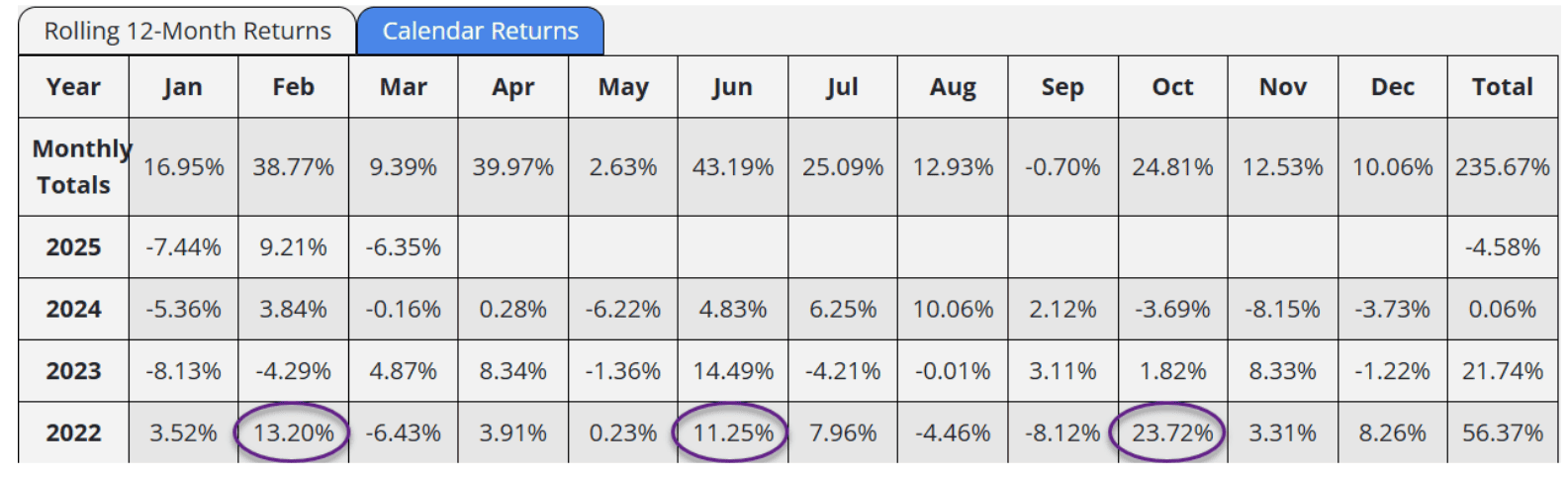
And this isn’t just theory. Check out the live trading returns of the Max 150 during the 2022 bear market: Its top 3 months generated 11%, 13%, and 24% returns (based on $150k funding level):
Caveat: While I have strong confidence in the long-term statistical edge of our strategies, that confidence doesn’t imply a specific timeline—and it should never replace prudent risk management of one’s portfolio.
Q. What are you and your other clients doing?
While this drawdown has undoubtedly been challenging, my personal analysis of the data—and my experience with similar periods over the past two decades—leads me to believe that this will follow the same pattern as prior drawdowns that ultimately led to new highs. For example, as some clients may recall, I doubled a trading account while helping others do the same during the 2008 financial crisis using the same techniques we trade today. And I knew far less then, than now.
Q. If my account is nearing my "uncle point"— what should I do?
First and foremost, it’s essential to prioritize your financial and mental well-being. If you’re running multiple units or programs, consider pausing some to reduce exposure and create more breathing room. This approach can help you stay engaged while managing risk at a level that feels more comfortable. (If you choose to pause a unit or program, we’re happy to apply any unused credit to your remaining accounts.)
If you’re trading a single unit and find yourself feeling overwhelmed, it’s okay to take a step back. Pausing for a few weeks or months can provide the mental clarity and confidence needed to re-engage when you feel ready. And don’t worry, there should be ample profit opportunities for a long time to come.
Ultimately, managing your individual risk is key. While we believe in the long-term potential of the programs, no one should remain in a position that exceeds their personal comfort level or financial risk tolerance. If you reach that level then it is time to contact your broker to stop the trading in your account. Making decisions that align with your personal situation is always the right choice, and we support you in doing what’s best for you.
Just a reminder: InvestiQuant is not a registered advisor and we do not provide individualized investment advice. For personal guidance, please contact your futures broker. That said, we’re always happy to help you better understand how our programs operate—feel free to reach out at [email protected].
Q. What should I expect during this high volatility period?
Periods of elevated market volatility behave differently than more stable trading environments and that has important implications for autotrading performance. In high-volatility conditions, trading results tend to swing more significantly in both directions. This means the average size of gains and losses increases. The key benefit? Opportunities for larger winning trades become much more frequent.
To illustrate, last week our Max 500 program achieved a milestone: a single-contract trade in the S&P 500 that generated $9,425 which is the largest one-contract trade we’ve ever had in the S&P.
As markets expand into wider trading ranges, more risk is naturally required to give trades the room they need to develop. All of our programs operate within strict daily risk budgets, typically ranging from 4-5% of the recommended initial funding amount. These safeguards are designed to keep risk exposure in check, regardless of market conditions.
When volatility becomes so extreme that a trade setup would exceed the program’s risk budget, the system will automatically stay on the sidelines. This self regulating, risk-aware feature ensures that we do not take trades that fall outside of our predefined limits.