
Most investors are surprised to learn just how much market exposure a single futures contract provides relative to the capital required to hold it. A single E-mini S&P 500 futures contract currently controls approximately $375,000 of market exposure, yet requires less than $30,000 in a futures account (margin) to trade.
That means a futures trader can access broad market exposure using a fraction of the capital required to buy the equivalent value in stocks or ETFs outright. This capital efficiency also allows investors to keep more capital in reserve, diversify across more strategies and markets, and size their risk more thoughtfully.
Example: SPY (S&P 500 ETF) vs ES Futures (S&P 500 Futures)
Suppose you have $30,000 to invest. If you purchase $30,000 of SPY, a 1% increase in the S&P 500 would generate a gain of approximately $300.
Now consider using that same $30,000 to buy one E-mini S&P 500 (ES) futures contract. Since one ES contract controls roughly $375,000 of the S&P 500, a 1% increase in the index would produce a gain of approximately $3,750 - more than 10 times the SPY.
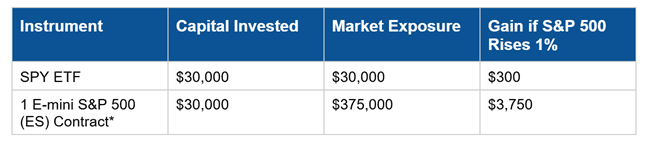
*example based upon the S&P 500 trading at 7500
The difference isn't that futures produce better returns, it's that they provide significantly more market exposure for the same amount of capital. This built-in leverage can amplify gains, but it can also amplify losses, which is why proper funding and risk management are so important when trading futures.
Capital efficiency is one of the core reasons systematic futures strategies, like InvestiQuant's autotrading programs, can pursue meaningful returns using relatively modest account sizes. It's also why micro futures contracts, which are one-tenth the size of a standard E-mini, have made systematic trading exposure accessible to a much wider range of investors than ever before.
That same leverage, however, is why funding levels matter so much in futures trading and why InvestiQuant publishes suggested funding levels for each program rather than simply listing a minimum. Our suggested funding levels are calibrated to cover the maximum daily margin the broker may require for each program, plus a meaningful buffer to withstand the normal ups and downs every trading program experiences. While some investors choose to fund with more or less than our recommendation, it's important to understand how that affects reported performance.
Let’s use an average year in the Multi 100 as an example of how this works. It has a suggested funding level of $100,000 and the average annual return is $44,200 per unit or 44.2% of the suggested funding level. If you were more aggressive in your funding and funded it with $80,000 it would still have the same return of $44,200 but the percent return would be 55.3%. If you were to be more conservative in your funding and start with $120,000 you would still have the same return of $44,200 but it would be a 36.8% return on your capital.
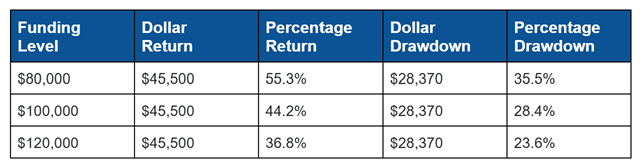
Funding at or above our suggested level gives a program more room to navigate the normal ups and downs that every investment experiences. Investors who choose to allocate more capital than recommended will see a lower percentage return, simply because the same dollar gains are spread across a larger account balance. Many investors prefer this approach because it aligns with a more conservative risk profile and lower percentage results also works on the downside, so when a drawdown happens the percent will be smaller there as well.
Some investors choose to allocate less than our suggested funding level. This will result in higher percentage returns when the strategy performs well, since the same dollar gains are measured against a smaller capital base. The tradeoff is that the account has less cushion during periods of normal market volatility and may require additional capital if market conditions become more challenging. For investors who actively monitor their accounts, this can be a reasonable approach. However, for most investors - especially those using retirement accounts or seeking a more hands-off experience - funding near or above our suggested levels offers a better balance between capital efficiency and long-term staying power.